Buying bogolan from Mali: questions about cloth and craft
A bogolan cloth can be a garment, a wall hanging or a piece bought for its maker’s work. Those uses call for different questions. Before comparing prices, establish what the seller is offering, who made it and how you intend to use it. A striking pattern alone cannot establish a cloth’s origin or production method.
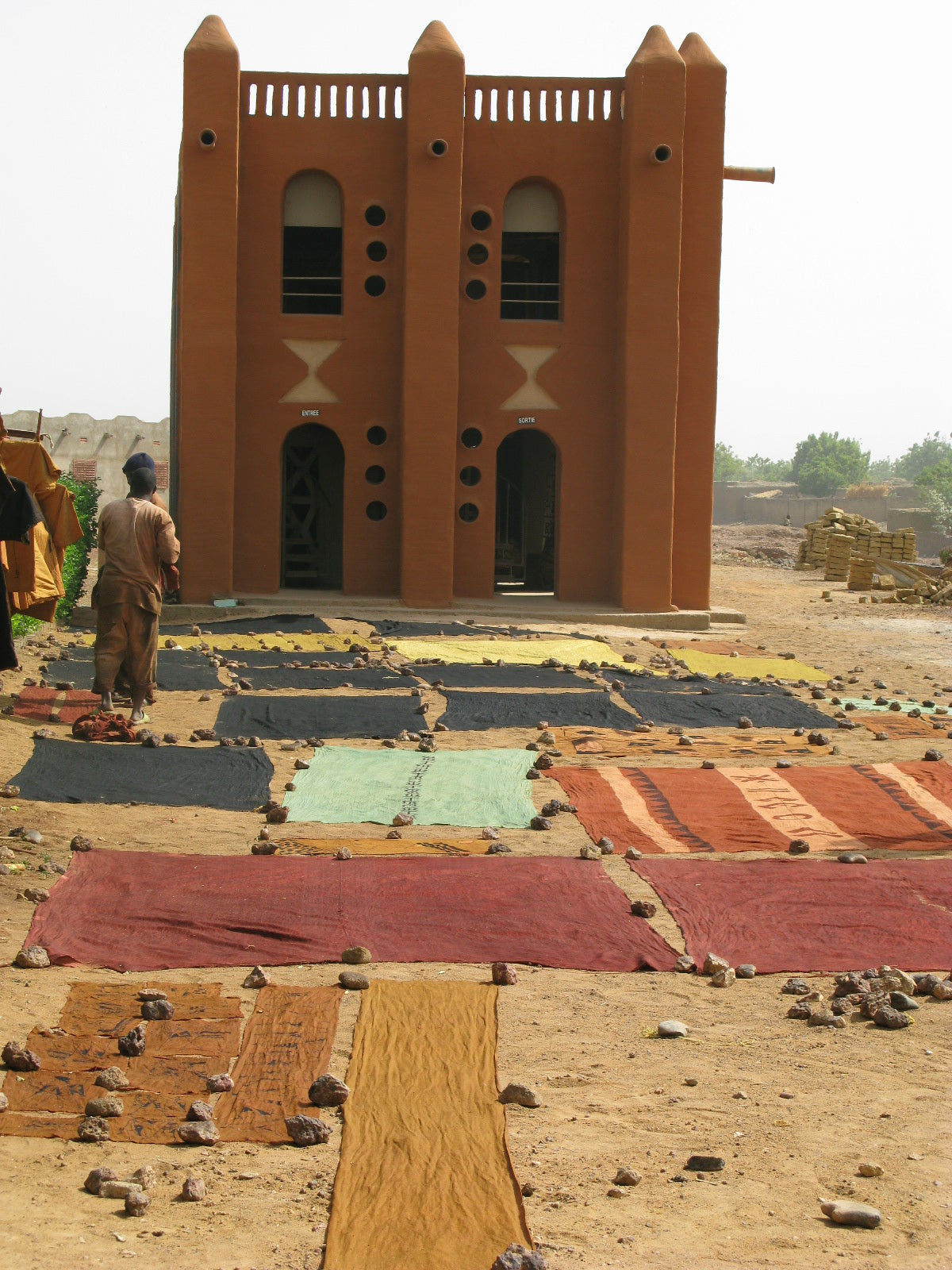
Cover photo: OBERSON, “Ségou (11)” (2008), Wikimedia Commons, CC BY-SA 4.0. Shows cloth laid out outdoors; a historical illustration, not a photograph of a seller reviewed here. Image resized and may be cropped by the page layout; any such adaptation is shared under the same licence.

What bogolan means—and why the description matters
Bogolan, also called bògòlanfini, is associated with Malian textile traditions. The Smithsonian explains the name through mud or clay and cloth, and documents its use in contemporary art and fashion as well as older practices. Its account distinguishes bogolan from batik and tie-dye: the background can be painted dark while the lighter design is left untouched. Read the Smithsonian introduction.
That background helps you read a listing, but it does not certify an individual item. “Mud cloth”, “bogolan-inspired” and “printed bogolan pattern” may describe different products. Ask the seller to distinguish the fabric, the colouring process and the design. A printed textile can be an intentional, useful purchase when it is described accurately; the problem is an unclear claim.
Start with the intended use
For a wall hanging, measure the available space and ask how the cloth can be supported without stressing its edges. For clothing or a cushion, discuss softness, usable width, seams and care with the person who will sew it. For a gift, request the maker’s name or workshop story, if the maker is comfortable sharing it, and written care instructions that can travel with the cloth.
Write down the finished size you need, rather than judging it from a photograph. Ask whether the dimensions include fringe or unfinished edges, and whether the quoted piece is the exact one shown. If the seller offers a custom order, clarify which details can vary between the sample and the finished work.
Ask about the hands behind the cloth
Useful questions are specific: who wove the base cloth, who coloured it, and where was the finished item made? One workshop may carry out several stages; another may work with separate weavers and dyers. Ask which stages are performed by hand and which use commercially produced materials. A transparent account is more useful than a broad claim such as “100% authentic”.
If a maker’s identity cannot be shared, ask for a non-sensitive explanation of the production process. Do not demand private addresses or personal documents. A seller may protect an artisan’s privacy and still describe the work clearly. Record what is confirmed, what is the seller’s account and what remains unknown.
Read patterns with context
Ask whether the maker gives a name or story to the design, and whether that explanation refers to this particular cloth. Avoid assuming that every triangle, line or dot has one universal meaning. The Smithsonian’s pattern documentation is useful further reading, but a reference example does not replace the maker’s explanation of a contemporary piece.
If you plan to reproduce a motif in packaging, a logo or merchandise, treat that as a separate conversation. Buying a cloth does not by itself answer questions about permission to reproduce a design, credit or cultural context.
What photographs should show
- The whole piece laid flat, with its measurements stated separately.
- A close view of the surface, seams and edges.
- The reverse side, where practical, to understand the construction.
- Any wear, repairs, marks or uneven areas relevant to the purchase.
- The exact available piece, rather than only a representative sample.
Ask for a neutral-light photograph if strong filters make the colour hard to judge. Small irregularities may be part of handwork, but they do not prove authenticity. Equally, neat stitching does not establish machine production. Use images to ask better questions, not to make a certificate from appearance.
Compare two offers on the same basis
Consider this hypothetical example: one seller offers a small finished panel with named maker information and care instructions; another offers a larger length with an unspecified production process. A lower total price does not tell you which better meets your needs. First compare the usable dimensions, intended use and information provided.
| Compare | Record before ordering |
|---|---|
| Material and process | Fibre, weaving and colouring method as described by the seller |
| Size and finish | Usable dimensions, joins, hems and included fringe |
| Provenance | Maker or workshop attribution, and which details are unverified |
| Condition | New or previously used; disclosed repairs and marks |
| Total purchase | Item, delivery, possible import charges and return arrangements |
Care, delivery and the final agreement
Do not assume that every bogolan cloth tolerates the same washing routine. Ask the maker or seller about washing, colour transfer, drying, ironing and prolonged sunlight for that specific item. If instructions are missing, resolve that before buying for a use that requires frequent cleaning. Do not test an entire valuable cloth using a generic internet recipe.
Confirm packaging, delivery destination, tracking and what happens if the received piece differs from the agreed description. For an international purchase, check the destination’s import requirements separately and distinguish the seller’s delivery estimate from a guaranteed arrival date. Keep the description, photographs and agreed terms together.
A short message you can send
“I would like to use this piece as [intended use]. Is it the exact cloth in the photos? Please confirm its usable dimensions, fibre, weaving and colouring process, maker or workshop attribution where available, care instructions, and the full delivery and return terms.”
Editorial note: This guide offers questions for an informed purchase. Africa Prisma has not inspected or authenticated a seller’s cloth and does not certify products. No seller paid for inclusion in this article.
← All stories