Ghanaian food: traditional dishes and everyday meals
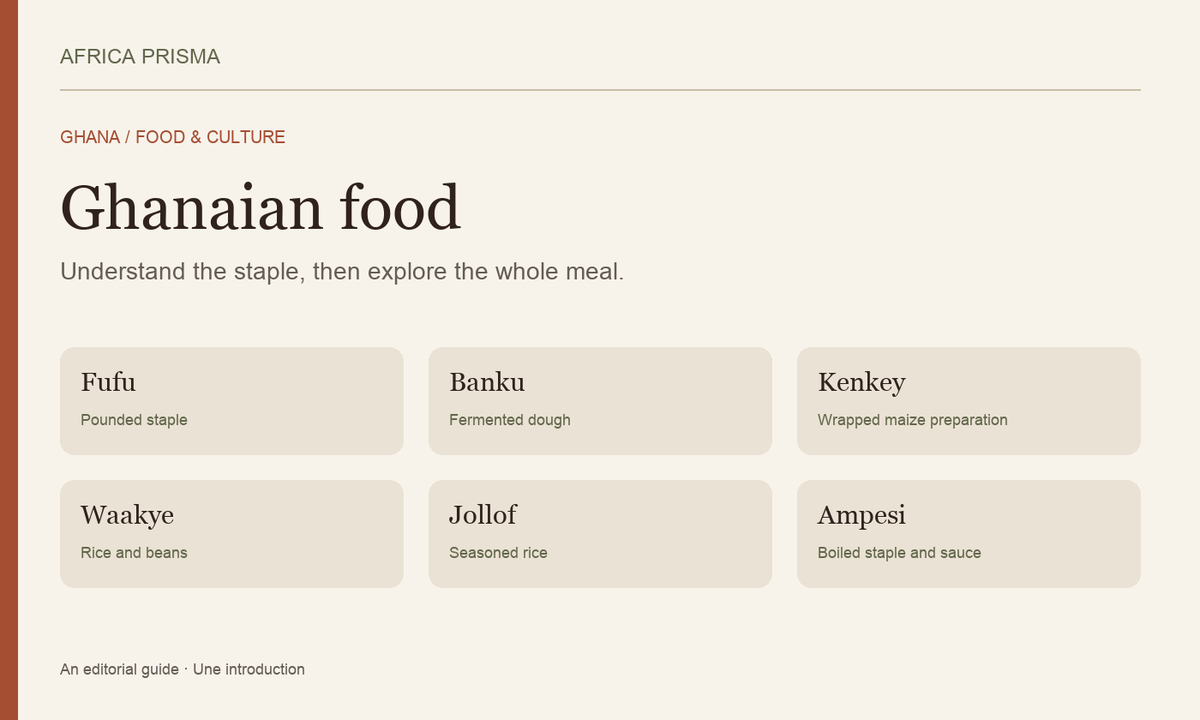
Ghanaian food is easier to understand when you look at the whole plate: the staple, the soup or stew, the protein and the accompaniments. A name such as banku tells you about one part of a meal. It does not tell you everything about its ingredients, heat or serving style. The same dish can also change between households and cooks.
This guide introduces widely recognised dishes, explains useful differences and gives you a practical way to order. It is for readers exploring their own food heritage as well as people encountering Ghanaian cooking for the first time. It is an introduction, not a ranking of an entire country's cuisine.
Ghana food at a glance: start with the meal's structure
Rather than memorising a long menu, start with three questions. What is the base? What accompanies it? Which ingredients are already mixed in? This separates a dish's familiar name from the particular version being served. It also helps when two people use slightly different spellings for the same food.
| Food | What to recognise | A useful question |
|---|---|---|
| Fufu | A pounded staple, served with soup | Which starches and which soup are used? |
| Banku | A cooked fermented-dough staple | What is today's accompaniment? |
| Kenkey | A fermented maize preparation cooked in a wrapping | Which variety is available? |
| Waakye | Rice and beans cooked together | Which toppings and sauces are included? |
| Jollof rice | Rice cooked with a seasoned tomato base | Is the stock or protein already in the rice? |
| Red red | A bean stew meal | What comes with the beans? |
| Ampesi | A boiled-staple meal, such as yam with a sauce | Which staple and sauce are being served? |
| Tuo zaafi | A staple associated with northern food traditions | Which soup accompanies it? |
These are orientation notes, not recipes. Ghana's National Commission on Culture describes food through combinations of staples, soups and accompaniments, with considerable regional variation. Its overview is a useful reminder that a single plate cannot represent every community. See The Ghanaian Kitchen.
Fufu, banku and kenkey: similar role, different preparation
Fufu: ask about both the starch and the soup
Fufu is a good example of why the base and the accompaniment should be described separately. The University of Ghana's international student handbook introduces a version made with pounded cassava and plantain, eaten with soup. That description is a useful starting point, but it should not be treated as a rule for every bowl. Source: University of Ghana handbook, food section.
When ordering, ask which soup is available and what protein is in it. If the answer is “light soup” or “groundnut soup”, follow up about the actual ingredients. A soup's name is not a complete ingredient list. If you are sharing a meal, check the number of portions before ordering rather than assuming one bowl is intended for everyone.
Banku: identify the dough and the accompaniment
Banku belongs to the group of fermented cereal preparations discussed in the FAO's technical account of African foods. Fermentation and cooking are distinct steps: the finished food is a cooked preparation. For a reader, the useful distinction is its preparation and texture, rather than treating it as interchangeable with a pounded staple. Source: FAO, fermented cereals.
A menu may name banku and a particular fish or soup together. Read that combination as the dish on offer. Ask whether pepper sauce is separate, whether fish is whole or portioned, and what is included in the quoted serving. These questions tell you more about your meal than a general description of “Ghanaian food”.
Kenkey: the wrapping is a useful clue
Kenkey is made from fermented maize dough and cooked in a wrapping. The FAO describes a process in which a cooked portion of dough is combined with uncooked fermented dough before shaping, wrapping and steaming. Wrapping materials and methods differ between varieties. This makes kenkey distinct from both fufu and banku, even when the three appear in the same discussion of staples.
If a seller offers more than one kind, ask what distinguishes them in that kitchen. Avoid judging a food solely from the wrapper: preparation, size and serving combinations also matter. Order the accompaniment deliberately, rather than assuming every kenkey meal comes with the same fish or sauce.
Waakye and jollof: two different ways to approach rice
Waakye: separate the cooked base from the additions
Waakye combines rice and beans. An account published by the International Rice Research Institute's Rice Today describes the use of sorghum leaves for its characteristic colour and notes its northern origins and wider popularity. It also shows how the base can be served with different additions, including egg, fish, meat, vegetables and sauces. Source: Rice Today, waakye.
The practical lesson is to order in stages. First choose the amount of rice and beans. Then ask which additions are available, which cost extra and which sauces can be served separately. Two waakye plates can therefore look very different without either being an error. A photograph of one serving is not a definitive template for all others.
Jollof rice: ask how this version is made
Jollof is rice cooked with a seasoned tomato base. Ghana Tourism Authority includes it among foods introduced in its visitor publications. You can use the name to recognise the broad dish, but the seasoning, stock and accompaniments still depend on the cook. Source: Ghana Tourism Authority, This Is Ghana.
For a useful comparison, pay attention to the rice's texture, the balance of seasoning and the accompanying food. You do not need to turn a meal into a contest between countries. If you are avoiding an ingredient, ask whether it is cooked into the rice; removing a visible piece of meat does not answer the question about stock.
Beans, boiled staples and smaller dishes
Red red offers another route into a meal built around beans. The National Commission on Culture lists bean stew among foods found in Accra. Ask what accompanies the stew, how the serving is put together and whether a sauce contains an ingredient you avoid. The dish name alone does not establish that a serving is vegetarian.
Ampesi is worth recognising when you want to understand a boiled staple served with a sauce. The University of Ghana handbook uses boiled yam as its example. Again, ask about both parts. A relatively simple-looking staple can arrive with a much more complex sauce, so it is better to ask what is in the full meal than to focus only on the visible yam.
Smaller dishes and snacks can broaden your introduction without requiring several large meals. Ask the seller for the local name, main ingredient and normal portion. Write those details down if you want to remember what you enjoyed. A short note about the actual preparation is more useful than saving an unlabelled photograph and later guessing its identity.
Regional food traditions are a starting point, not a border
The National Commission on Culture's overview associates akple and abolo with the Volta region and discusses tuo zaafi, leafy soups, tubaani, koko and koose in northern contexts. These associations help introduce variety. They do not mean that a food is eaten only in one region or that everyone from a region eats the same meals.
Use a regional description as an invitation to ask a better question: “How do you prepare this here?” A family, caterer or food seller can describe their own version more precisely than a national overview can. Migration, urban life and individual preference also make a rigid one-dish-per-region chart an unhelpful way to approach a living food culture.
For readers reconnecting with family food, record who uses a particular name, which language they use and which occasion they associate with it. Keep that account specific. “My family serves this at this gathering” is valuable information; it does not need to become a claim about every Ghanaian household.
A practical checklist for ordering a Ghanaian meal
- Choose the whole combination. Confirm the staple, soup or stew, protein and extras.
- Ask what is already mixed in. Stock, sauces and seasoning may matter as much as visible ingredients.
- Ask about heat before adding sauce. Request separate sauce where the seller can accommodate it.
- Describe dietary needs clearly. Ask specifically about groundnuts, fish, shellfish or other ingredients relevant to you. A dish name cannot guarantee their absence or separate preparation.
- Confirm portion and price. Establish whether additions are included before the meal is assembled.
- Record the version you tried. Note the dish, accompaniment and the seller's explanation rather than declaring it the only authentic version.
These questions also work when ordering food for a group. Collect each person's needs before choosing a shared set of dishes. If staff cannot confirm an ingredient or preparation method, treat that as unresolved rather than translating uncertainty into a reassuring answer.
Build your own three-meal introduction
Here is an editorial suggestion, not a traditional fixed menu. On one occasion, choose a rice-based meal and learn how its additions are selected. On another, choose a staple with soup and ask about the base and the soup separately. On a third, explore a bean or boiled-staple meal. This gives you useful points of comparison without ordering everything at once.
Keep the comparison concrete: which texture did you enjoy, which accompaniment changed the meal, and what would you ask for next time? If you already know these dishes, use the same approach to document a household variation or discuss preparations with relatives. The goal is a more informed conversation, not a checklist of foods to “complete”.
Questions readers often ask
Is Ghanaian food always very spicy?
A national label cannot predict the heat of a particular serving. Ask how the dish is prepared and whether pepper sauce is already included. Separate sauce gives you a choice only when the main preparation itself suits you.
Are fufu, banku and kenkey the same food?
No. They can occupy a similar place in a meal, but their ingredients and preparation differ. Pounding, fermenting, cooking and wrapping are useful distinctions to ask about.
Can I identify a vegetarian meal from its name?
Check the ingredients and preparation directly. Beans, rice or vegetables in a name do not establish what stock, fish or other additions have been used.
Sources and editorial approach
This guide draws on the linked Ghanaian cultural and university sources, FAO's technical account, IRRI's food contribution and Ghana Tourism Authority's publication. Older sources are used for food descriptions, not current restaurant listings or prices. The ordering checklist and three-meal approach are Africa Prisma's editorial suggestions.
Prepared with AI assistance from published sources; this is not a first-person restaurant review or field report. Recipes, spellings and serving practices vary. For more context, explore our Ghana coverage and culture stories.
← All stories